
IRCTC Coach Position & Seat Map Blueprint Guide (2026): Find Your Coach & Berth Before Train Arrival
Standing at the wrong end of a 24-coach train? Learn how Indian Railways orders coaches (SL, 3A, 3E, 2A, 1A), how platform escalator zones work, and explore interactive 2D berth blueprints.
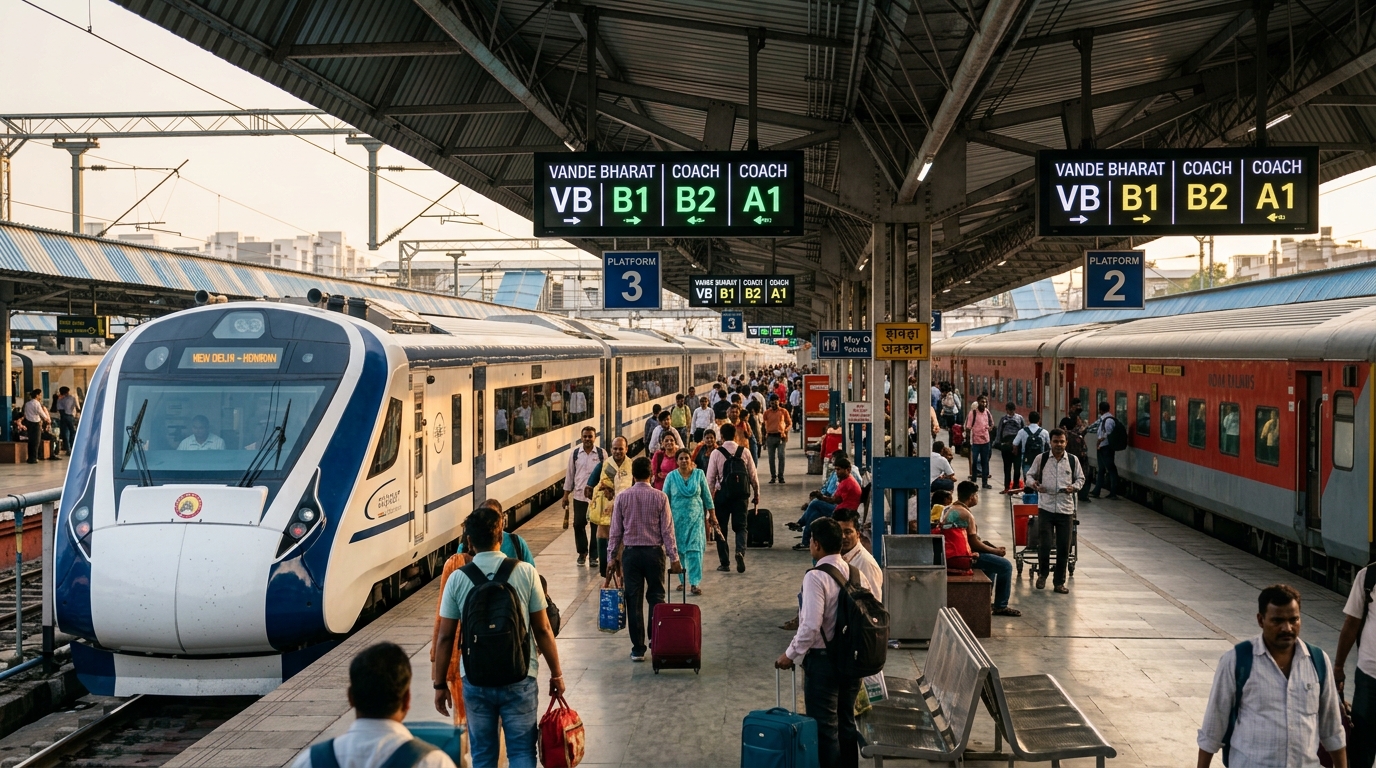
The Panic of the 24-Coach Rake: Why Platform Position Matters
A standard 24-coach Indian Railways express train stretches over 600 meters from the WAP-7 electric locomotive to the rear guard van. At high-frequency junction stations like New Delhi, Kanpur Central, or Howrah, trains often halt for only 5 to 10 minutes. If you wait on the platform without knowing where your coach will stop, you risk a frantic 500-meter sprint through surging crowds while hauling heavy luggage.
Pro tip: Most station foot-over-bridges (FOB) and escalators descend into the middle of the platform (typically near coaches 8 to 14). Knowing whether your coach is Engine-Side or Rear-Side lets you position yourself precisely before the train pulls in.
Standard Indian Railways Rake Composition Blueprint
While exact compositions vary by train zone, premier Superfast and Mail/Express trains following the standard LHB (Linke Hofmann Busch) rake architecture generally follow this sequence:
- Locomotive: High-power WAP-7 electric or WDP-4D diesel engine
- Front Power Car: EOG (End On Generation) / SLR (Seating cum Luggage Rake)
- General Unreserved (GS / UR): 2 to 3 unreserved coaches immediately behind the engine
- Sleeper Class (S1 to S7/S8): Non-AC sleeper coaches
- Pantry Car (PC): Centrally located for dining service distribution across AC and Sleeper
- AC 3-Tier Economy (3E): Modern high-density 83-berth AC coaches
- AC 3-Tier (B1 to B8): Standard 72-berth three-tier air-conditioned coaches
- AC 2-Tier (A1 to A3): Spacious 54-berth two-tier air-conditioned coaches without middle berths
- First AC (H1): Premier 24-berth luxury cabins and coupes
- Rear Power Car & General: Final GS coach and rear guard van
Understanding the New 3E (AC 3-Economy) Layout with Side Middle Berths
Introduced by Indian Railways to provide affordable air-conditioned travel, the 3E class replaces traditional 72-berth 3A coaches with an 83-berth layout. The critical difference is the addition of the Side Middle (SM) berth. In standard 3A, the side bay has only Side Lower (SL) and Side Upper (SU). In 3E, every side bay has SL, SM, and SU, meaning vertical headroom is reduced. If you book 3E, knowing your berth number before boarding helps you plan luggage storage and seating comfort.
Use Wayvia's Interactive 2D Seat Map & Spotlight Finder
Wayvia has engineered India's first fully interactive, 2D architectural coach position and seat layout tool. You can inspect exact door positions, restrooms (WC 1–4), central aisle walkways, and window orientations for all 7 coach classes (1A, 2A, 3A, 3E, CC, EC, SL). Enter your seat number, and our spotlight immediately pinpoints your exact berth with an animated beacon.
Explore Interactive Coach Position & 2D Seat MapsFrequently Asked Questions
Verified answers to the most common questions about this topic.